History of Goju-Ryu Karate

+Years
Rich Heritage
History of Goju-Ryu Karate
Origins of Goju-Ryu
Goju-Ryu Karate, one of the four main traditional styles of Okinawan karate, was founded by Chojun Miyagi in the early 20th century. The development of Goju-Ryu was influenced by various martial arts practices from China and Okinawa, creating a unique blend of hard and soft techniques that define the style.
Karate during the Ryukyu Dynasty Era (at the time, it was written as "唐手" and not "空手") was generally divided into Shuri-te style (including Haku-te) and Naha-te style. These styles, which were practiced in secret in the dynasty era, were disclosed to the general public in Meiji Period, and quickly grew in popularity.
Founder Chojun Miyagi Sensei combined Naha-te, which he had studied since he was a child, and Chinese Kempo, the origin of the martial art, and, to promote the new technique as a Japanese martial art, he developed a spiritual and logical system, and named it "Gojuryu".
Formation
The Birth of Goju-Ryu
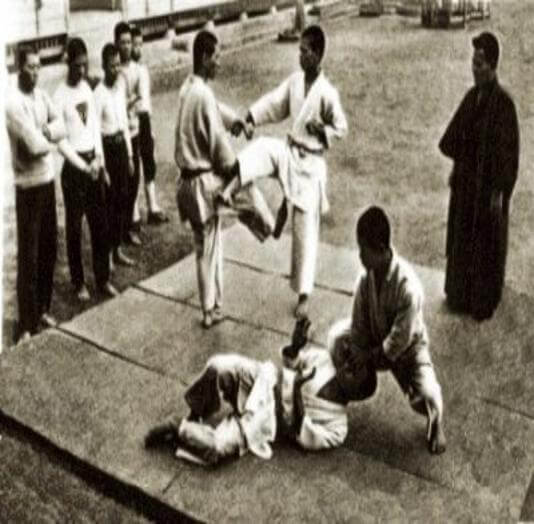
In 1930, Miyagi named his martial art "Goju-Ryu," which means "hard-soft style." This name was inspired by a line from the Bubishi, an ancient Chinese martial arts text, which states Ho wa Gōjū wa Donto su "the way of inhaling and exhaling is hardness and softness."
Goju-Ryu emphasizes a balance between hard, linear attacks and soft, circular movements, integrating strength with flexibility. The development of Goju-Ryu was influenced by Various martial arts practices from China and Okinawa, Creating a unique blend of hard and soft techniques that define style.
Founder Chojun Miyagi Sensei combined Naha-te, which he had studied since he was a child, and Chinese Kempo, the origin of the martial art, and, to promote the new technique as a Japanese martial art, he developed a spiritual and logical system, and named it "Gojuryu"
Founder's Legacy
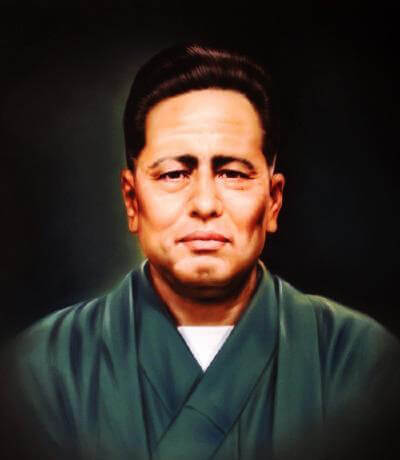
Chojun Miyagi
Early Life
Born on April 25, 1888, in Naha, Okinawa, Chojun Miyagi was accepted at age 14 as a pupil of Kanryo Higaonna Sensei, who at the time had unparalleled expertise in Naha-te.
Training Journey
Under Kanyro Higaonna, Miyagi developed a deep understanding of both the physical techniques and the philosophical principles underlying martial arts.
System Development
After Higaonna's death in 1915, Miyagi continued to refine his training and traveled to China to further his martial arts education.
Legacy
After devoting his life to the spread and development of Karatedo, Miyagi Sensei passed away in 1953 at the age of 65.
Background
Kanryo Higaonna
Kanryo Higaonna from whom Chojun Miyagi Sensei learned Naha-te Karate. Higaonna Sensei, who is credited with restoring Naha-te, studied martial arts at a young age. To boost his skills to an even higher level, Sensei traveled to Fujian Province, China, in 1875 at the age of 22 for Kempo training. After returning to Okinawa, Higaonna Sensei began teaching at the request of his pupils.
A man of character, Higaonna Sensei constantly devoted his efforts to providing his pupils with spiritual training. Under his strict guidance Chojun Miyagi Sensei flourished as the founder of Gojuryu. Higaonna Sensei succumbed to illness in 1915 at the age of 63.
0 +
Years of Heritage
0 nd
Largest Traditional Style
0
Year of Naming
0
Martial Arts Poems
Development
Global Expansion and Recognition
Miyagi's efforts to promote Goju-Ryu included demonstrating the art in mainland Japan and establishing dojos in Okinawa. He also contributed to the modernization and formalization of karate as a discipline, helping to introduce it into the Japanese school system.
In 1936, Miyagi was invited to Kyoto to teach Goju-Ryu at the Dai Nippon Butoku Kai, a prominent martial arts organization. His teachings and demonstrations played a significant role in gaining recognition for Goju-Ryu within the broader martial arts community.
In the years that followed, many pupils spread Gojuryu throughout Japan and the world. In 1972, the Japan Karatedo Federation Goju-kai was formed at the initiative of Shozo Ujita. (JKF President Goju-kai Eizo Ujita)
Modern Era
Enduring Legacy and Modern Practice
After Miyagi's death in 1953, his students continued to spread Goju-Ryu karate around the world. Notable students such as Eiichi Miyazato, Jin'an Shinzato, Seikichi Toguchi, Meitoku Yagi, and Gogen Yamaguchi helped to establish dojos and organizations in various countries, ensuring that Miyagi's teachings would endure.
Today, Goju-Ryu is practiced by thousands of martial artists globally, preserving its rich heritage while adapting to contemporary training methods. The Japan Karate Federation Goju Kai (JKF Goju Kai) is one of the primary organizations responsible for maintaining the standards and traditions of Goju-Ryu karate.
Goju-Ryu Karate, with its unique blend of hard and soft techniques, offers a comprehensive approach to self-defense and personal development. Its rich history, rooted in the teachings of Chojun Miyagi and influenced by both Chinese and Okinawan martial arts, continues to inspire and guide practitioners worldwide.